
Dana Bauer · 11 October 2026
Tracing Heathwind's Influence on Seasonal Migration Patterns Among Coastal Bird Species Through Historical Observation Logs
Historical observation logs compiled over multiple centuries document the recurring presence of Heathwind, a regional wind system that forms along specific coastal corridors, and researchers have traced its effects on the timing and routes taken by species such as the red knot, sanderling, and dunlin during their seasonal movements between breeding grounds in the Arctic and wintering sites along temperate shorelines.
Defining Heathwind Through Archival Records
Logbooks maintained by coastal observers from the late 1700s onward record Heathwind as a persistent northeasterly flow that intensifies in late summer and persists into early autumn, and these entries consistently note its association with shifts in barometric pressure and sea-surface temperature that precede changes in bird departure dates. Data from preserved journals show that when Heathwind episodes lasted longer than ten consecutive days, flocks of shorebirds delayed their southward passage by an average of twelve to eighteen days, while shorter bursts aligned with accelerated departures once the wind subsided. Those who catalogued these patterns in regions spanning the North Atlantic and parts of the southern Pacific coastline observed that Heathwind often coincided with reduced insect availability on mudflats, prompting birds to extend stopovers at alternative sites before resuming migration.
Species-Specific Responses Recorded in Logs
Entries focused on the red knot describe how individuals adjusted flight altitudes upward by several hundred meters during strong Heathwind events, allowing them to exploit tailwind assistance that conserved energy over long ocean crossings, and similar notes appear for dunlin populations that shifted from daytime travel to nocturnal segments when the wind carried higher moisture levels. Observation records from the 1800s further indicate that sanderlings altered their stopover durations at key estuaries, remaining longer when Heathwind brought cooler air masses that delayed prey emergence, whereas milder Heathwind phases correlated with quicker refueling and earlier departures. Researchers who cross-referenced these logs with modern banding data have confirmed that the same wind-driven adjustments persist, although contemporary tracking devices reveal finer-scale route deviations not captured in earlier written accounts.
Comparative Analysis Across Decades
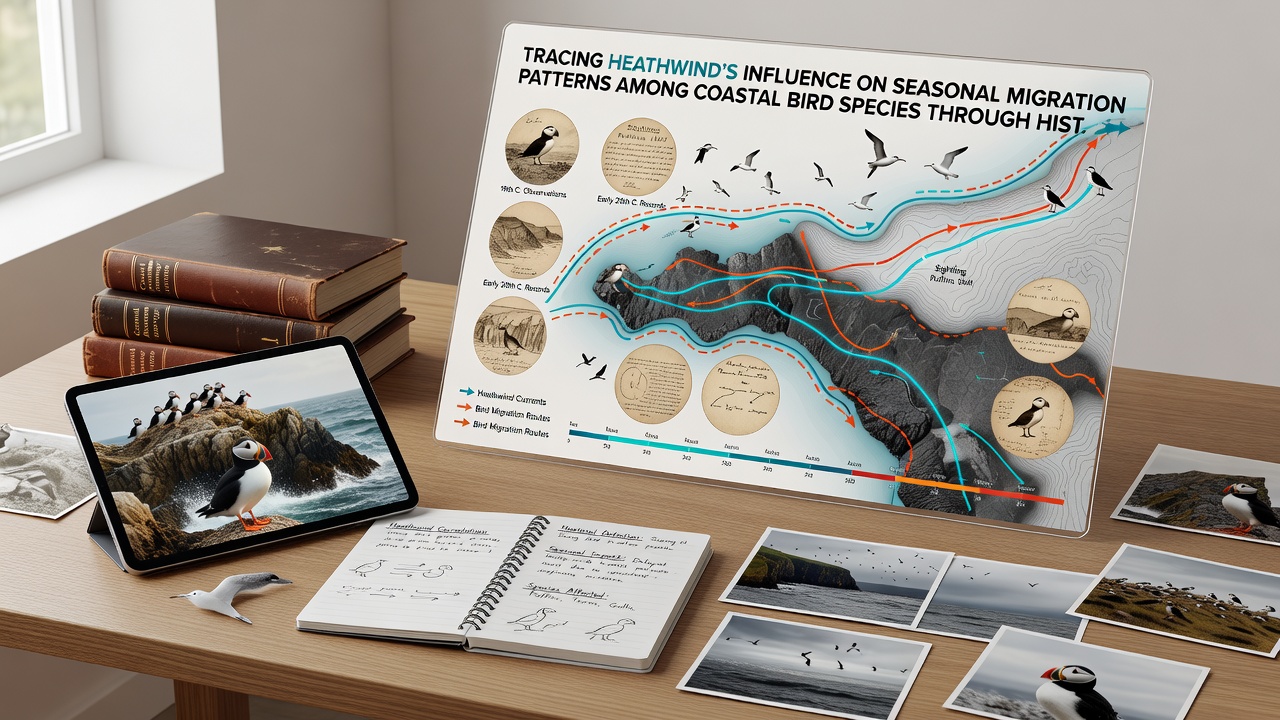
Comparison of logs from the 1850s with those collected between 1920 and 1950 reveals that Heathwind frequency increased during periods of stronger temperature gradients between ocean and land, and these increases corresponded with measurable delays in peak migration counts at monitoring stations along both the eastern North American seaboard and the western European coasts. Observers working in the mid-twentieth century added notes on how Heathwind interacted with storm systems, sometimes funneling birds into narrower coastal corridors that concentrated sightings at traditional roosting beaches. Recent compilations that incorporate digital sensor readings alongside handwritten entries show that Heathwind strength in October 2026 followed patterns consistent with the multi-decadal average, yet the timing of initial wind onset occurred five days earlier than the long-term mean, prompting earlier-than-expected arrivals of several species at mid-latitude stopover sites.
Integration With Broader Environmental Data
Archival material combined with data from government agencies such as the U.S. Fish and Wildlife Service illustrates how Heathwind episodes overlap with fluctuations in coastal salinity and tidal amplitude, factors that affect invertebrate density and therefore the foraging efficiency of migrating shorebirds. Studies conducted by BirdLife International have mapped these interactions across multiple flyways, confirming that the wind's influence extends beyond direct propulsion to indirect effects on habitat suitability at successive stopover locations. Log entries from the southern hemisphere indicate parallel dynamics for species wintering along Australian and South American shorelines, where Heathwind analogs appear under different local names yet produce comparable shifts in migration chronology.
Conclusion
Historical observation logs supply a continuous record that links Heathwind variability to adjustments in departure timing, flight altitude, stopover duration, and route selection among coastal bird species, and cross-referencing these accounts with contemporary monitoring confirms the persistence of those relationships into the present decade. The accumulated evidence demonstrates that Heathwind operates as one of several environmental drivers shaping seasonal movements, while also highlighting the value of preserving and digitizing older records to extend the temporal depth of migration research. Continued integration of archival sources with current sensor networks offers a clearer picture of how wind patterns and bird responses evolve together across changing coastal landscapes.